
Boge air compressors
When a compressor runs without a receiver, it compresses air in proportion to the load connected to it (the compressed air network). When the compressor is connected to a receiver sitting between the compressor and the load, it compresses air only up to a predetermined point. The rate can be controlled, and a suitable regulator ensures everything works as the user has set it.
Tehnogama’s head office is in the Municipality of Pećinci, in the industrial zone in Šimanovci, Dečka bb, immediately adjacent to the newly built bypass around Šimanovci. The location itself gives fast, straightforward links with every part of Serbia.
There are many applications for the compressed air that compressors produce: it can power air tools, fans and other similar tools and machines, it can inflate tyres and inflatable equipment, and much, much more. The industrial uses of compressed air are genuinely varied, and depending on the particular task compressors can be of different sizes and capacities, making them suitable for every possible application and adaptable to any specific compressed air requirement. With regular maintenance and proper care their service life is extremely long.

The advantages of equipment driven by compressors are several: they carry more power, and their speeds can be very much higher. That allows fast and precise work at the same time, since there are none of the fluctuations that can arise from a voltage drop in the mains, as happens with electrically powered machines or tools. Industrial compressors are also, one might say, environmentally sound products, because they are not throwaway items — they are built for long service, and the BOGE Kompressoren factory fits energy-efficient motors exclusively in all its compressors, with particular emphasis on the large capacities: motors that are more reliable, more efficient and reduce CO2 emissions into the atmosphere still further. Every BOGE compressor solution is an energy-efficient solution, and that is the primary task of the engineers working on the development of the BOGE product range.
Air compressors fall into two basic types: stationary and mobile. Stationary (fixed) compressors are used mostly in industry, and users choose them according to the capacity and pressure their production requires. They are available as base units or as units with integrated air receivers — that is, as “pack” versions consisting of compressor, air dryer and receiver, an “all in one” for users with limited or little room for a compressor room. The second type in the general classification of compressors are mobile (portable) compressors, intended for work in the field.
BOGE compressors are excellent machines, exceptionally reliable and well made, backed by a century of tradition and a team of highly qualified engineers working constantly on the development of still more efficient and reliable industrial compressors. The uses of compressors really have no limits. Whichever way you turn and whatever you pick up, know that an air compressor was involved at some stage in making it. Some compressors require oil lubrication, while others run entirely oil-free. BOGE offers both variants in its product range.
As with any purchased machine, compressors (piston or screw) also require regular maintenance whatever branch of industry they are used in — maintenance that safeguards the quality of the products compressed air is used to make, the machines the compressors drive, and ultimately the long service life of the compressors themselves. Attention must be paid to draining condensate from the air receiver regularly, to servicing the compressors on schedule, to replacing filters, belts, separators and so on, and to the conditions in the room the compressor is installed in.
Look after your compressor so that it serves you reliably and without interruption for many years. Compressors are the lungs of any plant, and for a plant to “breathe” and to “live”, this important factor of production — the air compressor — must be cared for.
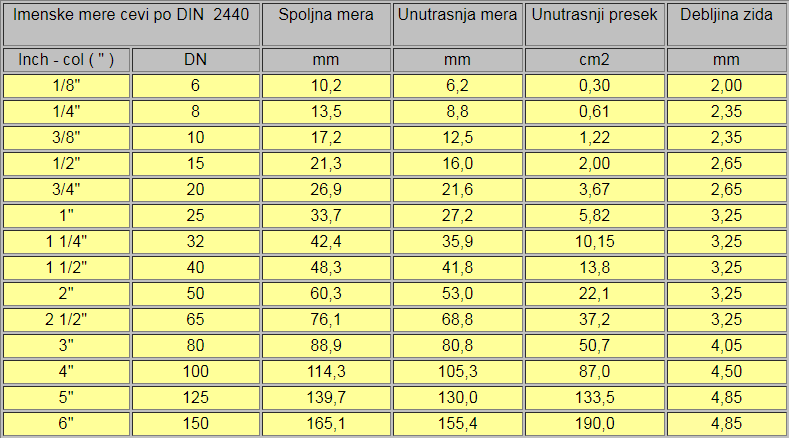
Steel pipe dimensions
OIL AND AIR SEPARATION IN SCREW AND ROTARY COMPRESSORS
An air/oil separator removes the compressor lubricant (oil) from the compressed air. In normal operation the oil returns to the oil reservoir while the compressed air goes on to the air receiver or the compressed air network. A typical oil separator reduces the oil content in the compressed air to 2–3 ppm. Under normal operating conditions the service life of an oil separator is 4,000–6,000 operating hours. Air/oil separators are commonly also called oil separators or oil removal elements.
The oil separator’s function
Most screw and rotary compressors inject compressor oil directly into the compression chamber, where the air, mixed with oil, is compressed. The oil serves several functions: it cools, lubricates and absorbs the heat generated by compression. The main advantage of using compressor oil as a coolant is that it creates a stable operating temperature for the compressor, which allows the compressor to run continuously whatever the duty cycle and production demands. Injecting compressor oil into the compression chamber does, however, create a problem, because the compressed air is full of oil when it leaves the airend. That oil has to be removed to protect the air system and to return the oil to the compression chamber for reuse. The main role in this part of an industrial compressor’s operation falls to the oil separator, which separates the compressor lubricant (oil) from the compressed air and returns the separated oil to the compression chamber.
Main features of the oil separator
- 01Reduces the oil content to 2–3 ppm.
- 02On installation the typical differential pressure is about 1.65 bar
- 03The separator element is replaced when the differential pressure falls to 0.83–1.10 psig
- 04Oil separators are compatible with both mineral and synthetic oils, but always make sure the replacement oil separator is compatible with the oil in the compressor.
Oil separators exist to give the compressor the longest possible service life in industrial use, but several things can destroy an oil separator, or shorten its life. For example:
- — contamination by unsuitable oil in the compressor
- — dirt getting past a fouled air filter
- — water from internal condensation caused by running in a cold space, or by poor air distribution / inadequate condensate drainage
Changing the compressor oil to the routine maintenance schedule set by each manufacturer, fitting drain valves and replacing the air filter regularly all help the oil separator work properly and effectively.
As already noted, oil separators are designed to run for 4,000–6,000 operating hours.
Their service life depends on many factors, among them:
- — the design of the industrial compressor itself
- — the quantity of liquid oil removed before it reaches the oil separator
- — the amount of dirt getting into the compressor through the intake filter
- — the type of oil/air separator (the oil separator’s design)
How to extend the service life of an air/oil separator
— A pressure drop in the oil separator, or too rapid a rise in differential pressure.
The most common cause is the separator element becoming blocked with dirt or water. If a physical inspection of the separator element shows dirt in it, check the condition of the intake air filter. If it is dirty, dirt will get past it and end up in the oil separator, so the air filter’s condition should be checked regularly and it should be replaced when needed.
— The presence of water
If an inspection of the oil separator shows water present, the problem usually comes from running in a cold space or from poor condensate drainage from the system. This form of contamination also leads to rust on and in the oil separator. The remedy is to fit drain valves on the system and to improve the ambient temperature.