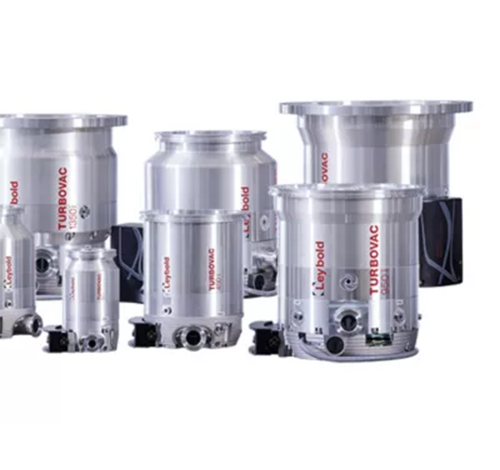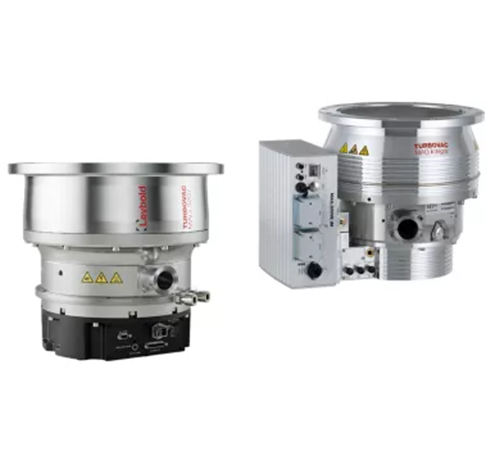
Mechanical, hybrid and magnetically levitated high-vacuum pumps
Leybold turbomolecular vacuum pumps are used in applications that require clean high or ultra-high vacuum — for example in nuclear fusion research and development, or in industrial fields such as the coating industry and analytical instrumentation.
In principle, a turbomolecular vacuum pump is a turbine rotating at high speed inside a housing, where the turbine stages carry a number of rotor blades. Between the rotating rotor blades sit stationary stator discs with blades arranged in the opposite direction.
Through momentum transfer from the rotating rotor blades to the gas molecules, the initially undirected thermal motion of the molecules is converted into directed motion from the pump’s inlet flange axially towards the fore-vacuum flange.
In the molecular flow range (i.e. at pressures below 10⁻³ mbar (0.75 × 10⁻³ Torr)) the mean free path of the gas molecules is greater than the gap between the rotor and stator blades (typically a few tenths of a millimetre). The molecules therefore mostly collide with the optically dense rotor blades, which results in highly efficient pumping. In the laminar (viscous) flow range (i.e. at pressures above 10⁻¹ mbar (0.75 × 10⁻¹ Torr)) the rotor effect is impaired by frequent collisions between the molecules themselves.
For that reason a turbomolecular pump cannot pump gases at atmospheric pressure.
Applications
- Nuclear fusion research and development
- Coating industry
- Analytical instrumentation
- Semiconductors and electronics
- High and ultra-high vacuum systems